The Magic of Oak: Wood in Beer, Cider, and Mead
There's a moment in every barrel-aged batch where something clicks. The harsh, tannic edge softens. The fruit comes forward. A faint vanilla warmth settles into the background like it was always there. You didn't add vanilla. You didn't add anything — you just waited, and the wood did the work.

There's also a risk, too much oak, harsh tannins, oxidation that mutes all of the good flavors, and even bacterial contamination. But with the risk can come great rewards, and a little knowledge can mitigate those risks.
That moment isn't magic. It's organic chemistry. And once you understand what's actually happening inside a barrel — or inside that bag of oak cubes sitting in your secondary — you'll stop treating wood as a mystery ingredient and start using it like the precision tool it is.
While we are largely dealing with tannins, wood is different than enological tannins that have been engineered for specific tasks. We will cover those in another article.
Let's dig in. As usual, this is a fairly detailed and long form post, but needed to be as comprehensive as possible.
What Wood Actually Is (Chemically Speaking)
Oak isn't just a flavor delivery system. It's a structural matrix of four overlapping chemical families, each of which behaves differently when heat and alcohol get involved.
Cellulose is the backbone — the structural fiber that holds the wood together. It's largely inert from a flavor standpoint, but it's the reason barrels don't collapse.
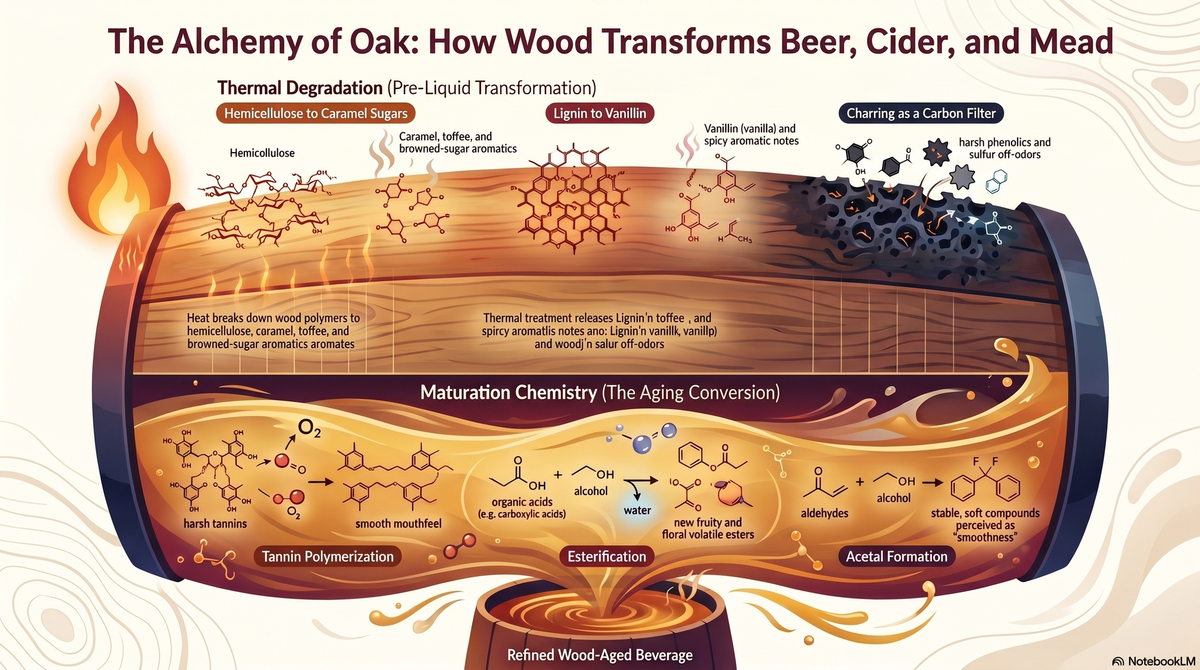
Hemicellulose is where your caramel and toffee come from. When the cooperage applies heat during toasting, hemicellulose breaks down into simple sugars and degradation products. The more heat, the more pronounced those browned-sugar aromatics become.
Lignin is the polymer that binds the wood fibers together, and it's the source of your vanilla. Under heat, lignin breaks down into a family of aromatic aldehydes — most notably vanillin — along with spicy phenolics. When people say a barrel-aged mead has "vanilla and spice," they're tasting lignin degradation products. Worth knowing.
Extractives round out the picture. This fraction includes the tannins and — critically — oak lactones, which drive that distinctive coconut and fresh-wood sweetness you get from American oak in particular.
Here's the piece most people misunderstad: the toast level of your oak completely reshapes which of these compounds you're extracting. A light toast preserves more raw tannin and fresh wood character. A heavy toast pushes the hemicellulose and lignin breakdown much further, loading the wood with caramel and vanilla. Go to charring territory, and you create a carbon-rich matrix that actively filters out harsh phenolics and volatile sulfur compounds — the same principle behind activated carbon filtration.
Tannins: The Structural Framework
Tannins deserve their own section because most brewers treat them as an enemy when they're actually one of your most important tools.
Tannins are what give a well-aged beverage structure, body, and a dry, clean finish. The infamous "puckering" sensation — astringency — is a tactile reaction, not a flavor: tannins bind to the lubricating proteins in your saliva and precipitate them out. That's the drying sensation you're feeling.
In a properly aged beverage, tannins integrate. They contribute to mouthfeel without dominating. When extraction outpaces the aging process, you end up "over-oaked" — the astringency is front and center and won't let you taste anything else. This is the most common mistake with oak adjuncts, and it's almost always a timing problem.
Primary Fermentation: Oak as an Editing Tool
Most people think of oak as a post-fermentation addition. And for the primary aging use case, that's correct. But introducing wood during active primary fermentation is a legitimate technique with real biochemical justification — and it's underutilized in the hobby.
Two things happen when you put oak in during primary:
Subtractive aromatics. Oak's porous microstructure physically traps volatile sulfur compounds and vegetal pyrazines — the stuff that causes asparagus and green pepper off-notes. By stripping those masking odors early, you allow the natural fruitiness of your honey, apples, or grain bill to come through cleanly. Think of it as clearing the room before your ingredients try to have a conversation.
Sacrificial tannins. Wood tannins introduced during active fermentation are highly reactive. They bind with suspended yeast proteins and fruit solids and drop out of solution, which serves two purposes: it protects the beverage from premature oxidation, and it preserves the native fruit-derived tannins that contribute to long-term color stability and structure. The added tannins sacrifice themselves so yours can survive.
What Actually Happens During Maturation
Once active fermentation is complete and your oak is in contact with the beverage, you're running a continuous overlapping process of extraction, oxidation, and chemical rearrangement. Ethanol and water are working as a mixed solvent — ethanol pulls aromatic compounds, water dissolves sugars and tannins — while the slow ingress of oxygen through the wood drives three major transformations.
Tannin Polymerization
Trace oxygen slowly oxidizes phenolics, causing tannins and color pigments (anthocyanins, relevant in fruit meads and ciders) to link together into larger polymer chains. Eventually these chains get heavy enough to precipitate out of solution. The result: color stabilizes, and the raw, harsh bitterness of young tannins shifts into a smooth, integrated mouthfeel. This is why barrel-aged beverages "round out" over time. It's not mystical — it's polymer chemistry.
Esterification
Ethanol and other alcohols slowly oxidize into aldehydes, then into organic acids. Those acids react with alcohols in the liquid to form new esters — fruity, floral volatile compounds — plus water. This is where complexity comes from. Esterification is why a barrel-aged mead smells like something you couldn't have deliberately added.
Acetal Formation
Aromatic aldehydes — whether extracted from the wood or generated through oxidation — react with alcohols to form acetals. This conversion neutralizes pungent "green" aldehydes and redistributes them into softer, more stable compounds. When tasters describe a beverage as "smooth," they're often perceiving acetal formation.
The Homebrewer's Oak Toolkit
Not everyone has a cellar full of used bourbon barrels. (If you do, I want to talk.) For the rest of us, the oak adjunct market has gotten genuinely good — but the products are not equivalent, and the combination of wood species, toast level, and physical format all matter. Getting those three variables right is the difference between a beverage that tastes intentionally aged and one that tastes like a 2x4 fell into the fermentor.
Choosing Your Format
The physical shape of your oak dictates how fast it extracts and how much complexity it can deliver. The surface-area-to-volume ratio is the key variable: more surface means faster extraction, but also less of the thermal gradient that makes barrel aging interesting.
| Format | Contact Time | Character | Best For |
|---|---|---|---|
| Beans / Dominos | 4–8 weeks | Fast, fairly even extraction; decent complexity | Quick turnaround batches, blending experiments |
| Cubes | 3–12 months | Layered extraction; thermal gradient from surface to core | General-purpose secondary aging |
| Spirals | 2–6 months | High surface area, accelerated but nuanced; easy to pull | Balanced extraction without a year-long commitment |
| Staves | 6 months–2+ years | Closest to barrel geometry; slow, deep integration | Long-term aging, big-format fermenters |
Beans and dominos are small-format cuts that extract faster than cubes but slower than chips. Useful when you want reasonably quick results without the tannin-dump risk of chips. Good for test batches before committing to a longer stave run.
Cubes are my general-purpose recommendation. The thicker geometry creates a natural thermal gradient — more heavily toasted on the exterior, rawer toward the core — that mimics how a barrel wall releases compounds in sequence over time. Patient tools. Reward patience.
Spirals are the format I reach for most often with meads and ciders. The spiral cut exposes both cross-grain and long-grain surfaces simultaneously, which accelerates extraction without the harshness of pure end-grain exposure. They're also easy to pull when you hit your target — no fishing around for scattered fragments. The Barrel Mill makes good ones; MoreBeer and Northern Brewer both carry them.
Staves are the barrel-without-a-barrel option. Large surface area, slow extraction, long-grain geometry. If you're aging a big imperial stout or a long-term traditional mead and you want to get as close to actual barrel character as possible without buying a barrel, staves are the move.
Skip chips and powders. Chips extract too fast and too harshly — high end-grain exposure dumps tannins before the more nuanced aromatic compounds have time to integrate. Powders and liquid essences are one-dimensional. Neither one belongs in anything you've spent months making.
Spirals and staves are my favorite for long-term, multiple month bulk conditioning, and can be reused a few times. I tend to deep freeze them after use and rinsing. In reusing - these are a better vehicle when carrying a spirit soak. You get more whisky/whiskey/gin/brandy/wine flavors that carry more weight in a beverage, with less tannin push. You will need to account for that, tasting as you go.
Choosing Your Wood Species
This is where the toolkit gets interesting. American, French, and Hungarian oak are the industry standards and what you'll find at any homebrew shop. But the exotics — available from MoreBeer, Craft a Brew, Great Fermentations, and a handful of other online retailers — are worth knowing.
The Oaks
American Oak (Quercus alba) is the bold one. Higher lactone content than French oak, which means more pronounced coconut and fresh-wood sweetness alongside the classic vanilla. Lower tannin density, so it's more forgiving on contact time. The standard for anything bourbon-adjacent — barrel-aged stouts, braggots, cysers. Available in light, medium, medium-plus, and heavy toast at most retailers.
Light — Fresh wood, raw vanilla, faint coconut, mild tannin
Medium — Sweet butterscotch, caramel, vanilla cream, toasted grain
Medium-Plus / Heavy — Campfire, roasted coffee, dark caramel, smoke, char
Fire-toasted cubes (Stavin makes them; MoreBeer carries them) are worth the premium over convection-toasted. The whole stave is toasted before cutting, so each cube has a gradient from heavily charred surface to raw core — exactly what you want for complexity.
French Oak (Quercus petraea / Quercus robur) is the restrained, European option. Denser grain structure, higher tannin content, more subtle extraction. The lactone profile is quieter — less coconut, more elegant spice and dried fruit. Better suited to delicate meads, traditional ciders, and anything where you don't want the wood to announce itself.
Light — Subtle spice, fresh wood, light vanilla, higher tannin presence
Medium — Coconut, vanilla, cinnamon, dark chocolate, smooth mocha
Heavy — Roasted coffee, dark chocolate, smoke, savory spice
If you're aging a show mead or a traditional where the honey character is the point, French oak light-to-medium is usually the better choice over American. It supports rather than competes.
Hungarian Oak (Quercus petraea) sits between American and French in most characteristics — tannin structure closer to French, flavor intensity somewhere in the middle. Often described as smooth vanilla with less of the bold coconut push you get from American. Underused in the homebrewing world, probably because it's harder to find. Worth seeking out if you want a more muted, integrated oak presence.
Medium — Smooth vanilla, mild spice, gentle caramel, soft tannins
Heavy — Toasted bread, caramel, dark fruit, moderate smoke
The Exotics
These are not widely stocked at brick-and-mortar homebrew shops, but MoreBeer, Craft a Brew, Great Fermentations, and HomeBrewIt carry most of them online.
Amburana (Amburana cearensis) — also called Brazilian oak, though it's not technically in the oak family — is the one worth knowing. It's the traditional aging wood for cachaça, and it's been making waves in craft brewing. The flavor profile is unlike any oak: gingerbread, baking spices, cinnamon, vanilla, and a herbal edge that some describe as thyme. It also tends to reduce perceived acidity in a beverage, which makes it particularly interesting for high-acid ciders and fruit meads where you want the fruit to come forward.
One important caveat: amburana extracts fast. Taste weekly. What takes American oak months to deliver, amburana can accomplish in a few weeks. The spirals are the easiest format to control.
Light — Floral vanilla, gingerbread, herbal notes, soft spice
Medium — Cinnamon, caramel, maple syrup, butterscotch, graham cracker
Acacia (Robinia pseudoacacia / Acacia senegal) is a European winemaking staple that almost nobody uses in homebrewing. Lower tannin structure than any of the oaks, which means it contributes aromatics without imposing structure. The flavor profile leans floral and honey-forward — vanilla, white flowers, subtle sweetness — which makes it worth considering for traditional meads and delicate melomels where you want a whisper of wood complexity without tannin interference. Contact time is moderate; it's forgiving.
Cherry Wood (Prunus serotina) brings a different flavor dimension entirely: stone fruit, subtle nuttiness, mild sweetness, and a faint floral quality. Lower tannin content than oak. It's a natural pairing for fruit-forward meads — cherry melomels especially, where it reinforces rather than competes with the base — and for farmhouse ciders with stone fruit additions. Available in spirals and cubes from a few online retailers; not common at physical shops.
Maple (Acer saccharum) is the sweetness-forward option. Softer tannin profile, pronounced caramel and vanilla with a distinctive maple sugar note, sometimes with a light smokiness at heavier toast. Interesting in braggots, bochet-style meads, and fall-harvest ciders. Not as widely available as the others, but Great Fermentations and a few specialty retailers carry spirals.
Quick Reference: Wood Selection by Beverage
| Beverage Style | First Choice | Worth Trying |
|---|---|---|
| Traditional / Show Mead | French oak, light-medium | Acacia, Hungarian |
| Fruit Mead (berry/stone fruit) | American oak, medium | Cherry wood, Amburana |
| Bochet / Braggot | American oak, medium-heavy | Maple, Amburana |
| Cyser / Apple Mead | French oak, medium | American oak, Cherry |
| Barrel-Aged Stout / Porter | American oak, heavy | Amburana, Maple |
| Farmhouse / Saison | French oak, light | Acacia, Cherry |
| Traditional Cider | French oak, light | Acacia, Hungarian |
| Fruit Cider | American oak, medium | Cherry wood, Amburana |
The Bourbon Soak
One of the smartest tricks in the adjunct-oak toolkit is soaking your wood in spirits — bourbon is the classic choice, but whiskey, rum, brandy, and wine all work — before adding it to your beverage.
Here's why it works: the spirit acts as an upfront solvent, pre-extracting the harshest tannins from the wood surface. Meanwhile, the wood absorbs the complex, already-oxidized flavors of the spirit. When you add the soaked oak to your fermenter, you're getting the layered character of barrel-aged spirits without the micro-oxygenation problem that comes with a new, uncharred barrel.
Soak for 2–4 weeks minimum, discard the soaking liquid (it's tannic and rough), and then add the wood to your secondary.
If You're Using a Real Barrel
Actual barrel aging adds a dimension that adjuncts can't fully replicate: the breathing cycle. As ambient temperatures rise, your beverage expands into the wood's micro-fractures. As it cools, it contracts and pulls extracted compounds back into the bulk liquid. This push-pull is what makes barrel-aged products taste the way they do — the flavor isn't just extracted, it's rhythmically integrated.
Working with barrels requires some maintenance discipline, but it's not complicated.
Swelling a new or dry barrel: Before filling, you need to swell the wood to seal the staves. Pour roughly 20% of the barrel's volume in hot, steamy water, slosh it around thoroughly, and let it sit until leaks stop. Hot water swells faster than cold and doesn't strip as much oak flavor as a full water fill would.
Cleaning after emptying:
- Rinse thoroughly to remove lees
- For deeper cleaning, use an alkaline solution — sodium carbonate or sodium percarbonate works well — to dissolve tartrates and residue
- Follow with a citric acid rinse to neutralize the alkaline solution
- Don't let the barrel sit dry
Storage between fills: Keep the barrel wet using a holding solution of citric acid and potassium metabisulfite. This keeps the wood swelled, inhibits biological activity, and preserves the barrel for its next use. A dry barrel cracks; a sour barrel ruins batches.
Getting It Into the Bottle
A few final hazards between your barrel or fermenter and the finished package.
Oxygen management is the critical variable at this stage. Every transfer is an opportunity for oxidative damage — dulled color, stale flavors, and the ever-present risk of feeding Acetobacter, which will convert your alcohol to vinegar with enthusiasm. Purge receiving vessels with CO₂, transfer under pressure or via siphon, and minimize splashing.
Fining Agents: Use With Caution
Two-stage chemical fining systems like Kieselsol/Chitosan (sold as Super-Kleer and similar products) are effective clarifiers. But they come with real tradeoffs worth knowing before you dump them in:
- They may strip delicate fruit character
- They may bind to and reduce organic acids — malic and tartaric specifically — which can flatten your acidity
- They may inadvertently introduce bitterness or astringency
For a barrel-aged product where you've spent months developing complexity, aggressive fining is a meaningful risk. Consider cold crashing and time over chemical intervention when possible. Fine if you are planning to filter, and bench trial finings before committing to your entire batch volume.
Stabilization and the Sorbate Problem
If you're back-sweetening a still mead or cider, you need to stabilize against refermentation. The standard approach is a combined dose of potassium metabisulfite and potassium sorbate. This works reliably — with one serious exception.
If your beverage has undergone malolactic fermentation (MLF), do not use potassium sorbate. Malolactic bacteria react with sorbate to produce 2-ethoxyhexa-3,5-diene — the permanent, unfixable "geranium" off-flavor. It doesn't fade with time. It doesn't blend out. It just sits there, smelling like a plant nursery, reminding you of the decision you made.
If you suspect MLF has occurred — soft acidity, slightly reduced malic sharpness, any lactic character — either confirm it's complete before using sorbate, or stabilize through pasteurization or sterile filtration instead.
The Bottom Line
Wood aging is not a passive process. It's a controlled chemical environment that rewards understanding. Know your oak format and its contact window. Know what toast level you're working with and what compounds it's biasing toward. Respect the tannin timeline. And if you're going into a barrel, maintain it like equipment, not furniture.
The moment when a batch clicks into place — when the oak becomes invisible and the beverage just tastes right — that's not an accident. That's chemistry working the way it's supposed to when you give it the conditions it needs.
Have questions about oak selection, toast levels, or barrel maintenance? Drop them in the comments — this is one of those topics that generates good conversation.
References & Further Reading
- Barrel Aging Explained (Timber Creek Distillery) – Details the foundational science of wood, thermodynamic pathways of toasting/charring, and the oxidation/extraction timeline.
- Impact of Barrel Kinetics and Dynamics on Wine (WineMakerMag) – Explores micro-oxygenation, the inhibitory effects of ellagitannins on bacteria, and differences in extraction rates based on cross-cut versus long-grain wood.
- Basic Barrel Care Techniques | Cleaning | Storage | Maintenance (BeerCo.com.au) – Outlines practical methods for swelling barrels and creating citric acid/metabisulfite holding solutions for wet storage.
- Barrel Care (Wine Machinery Group) – Provides technical parameters for barrel sanitation using high-pressure cold water, hot water, and steam to penetrate the staves.
- Wine Barrel Maintenance (Purdue Extension) – A comprehensive guide on the lifecycle of a barrel, oxygen ingress, and proper microbial maintenance to prevent spoilage.
- The Use of Barrels in Winemaking (OENO One) – A scientific breakdown of the specific chemical changes that occur inside the wood depending on the degree of toasting (light, medium, and heavy).
- Kieselsol and Chitosan in Fruit Meads (Experimeads) – Discusses the mechanism of polar fining agents and sensory trials revealing how they can inadvertently strip delicate fruit aromatics and alter acidity.
- 9. The Mead Making Process & 10. Advanced Topics in Mead-Making (Beer Judge Certification Program) – Authoritative guidelines covering fining, stabilization, potassium sorbate reactions with malolactic bacteria, and packaging risks.