Mead Architecture: Tannins in Mead Making
Honey is generous. It gives you sugar; it gives you aroma; it gives you that ineffable floral complexity that makes mead worth making. What it doesn't give you is structure. No tannins. None. Zip.

Every grape that's ever become wine arrived at the crush pad carrying its own skeletal framework — those polyphenolic compounds that give a finished beverage its backbone, its grip, its reason to exist beyond sweetness. Honey doesn't do that.
Which means you have to.
This is one of those things that separates the mead makers who've done some reading from the ones who've done some thinking. Understanding tannins — where they come from, how they behave, and when to use them — is probably the single biggest lever you have for taking a fermented honey-water from "pleasant" to "memorable."
(A note before we dive in: oak-derived tannins are their own rabbit hole. We'll cover that territory separately in a deep dive on Wood in brewing and mead making. This article is about everything else.)
What Tannins Actually Are (And Why They Get Weird)
Tannins are polyphenolic compounds. That's the chemistry textbook answer. The practical answer is that they're the thing that makes your mouth feel dry after a big red wine — that puckering, slightly grippy sensation on your palate. They bind to proteins, including the ones in your saliva, which is why high-tannin beverages create that drying effect.They provide a "structure" to mouthfeel, while helping to stabilize color.
In a mead must, the extraction behavior of tannins is governed by your solvent. Early on, that solvent is mostly water, and water is excellent at pulling tannins out of whatever you've added them to. As fermentation progresses and ethanol climbs, you're now working with a mixed solvent, and the way phenolic compounds dissolve and present on the palate shifts meaningfully.
Here's the part I find genuinely interesting: during active fermentation, yeast in rapid multiplication generates an enormous concentration of suspended cellular proteins. Tannins are highly reactive with protein. If you've added tannins to an active must, they will immediately start binding to those suspended yeast proteins and fruit solids, forming heavy complexes that precipitate out as gross lees. You're essentially using tannins as a natural clarifier — and we'll come back to why that's actually a feature, not a bug.
Your water matters more than you think. The mineral profile of your base water changes how tannins land on the palate in ways that bench trials will demonstrate immediately:
- Sulfates push bitterness and sharpen the finish. In a highly tannic mead, elevated sulfate will take "pleasantly dry" and drag it straight into "harsh and astringent." Something to keep in mind if you're building your water profile from scratch.
- Water hardness is a reliable enemy. Hard water tends to produce meads that read as flat, hot, and waxy, with elevated and unpleasant phenolic character. Soft water profiles consistently outperform — brighter acidity, smoother phenolic integration, better overall approachability. If you haven't done a side-by-side on this, it's worth the experiment.
Not All Tannins Are the Same
When you walk into a homebrew shop and look at the tannin options, the shelf can be misleading. They're not interchangeable. Here's what you're actually looking at:
Gallo-tannins (BrewTan B and similar) are the darlings of the beer world. They're extracted from gall nuts, they're powerful antioxidants, and brewers use them early in the process to precipitate unstable proteins and prevent staling. You could use them in mead. I'd steer you elsewhere. The wine and mead world has moved toward specialized enological tannins for a reason — they're formulated to integrate cleanly into the flavor matrix without leaving a harsh, woody, or astringent residue. For mead, use tools made for the job.
Generic grape tannins are what most homebrew shops stock as a catch-all. They're condensed tannins from grape skins or seeds, but "grape tannin" on the label covers a lot of ground:
- White wine tannins tend to be sharper, highly reactive, more astringent. Think of them as structural bite in very small doses. They'll overwhelm fast — start your bench trials at no more than ¼ to ½ tsp per gallon (roughly 1–2 mL per liter) and work from there. Always dissolve the powder in water before adding it to your must.
- Red grape tannins come from red grape skins specifically, and they tend to be softer and more polymerized. They contribute to color stability and a rounder, fuller mouthfeel. For melomels, these are generally more forgiving to work with.
Specialized enological tannins are where precision lives. Scott Labs products have become go-to references for competitive mead makers:
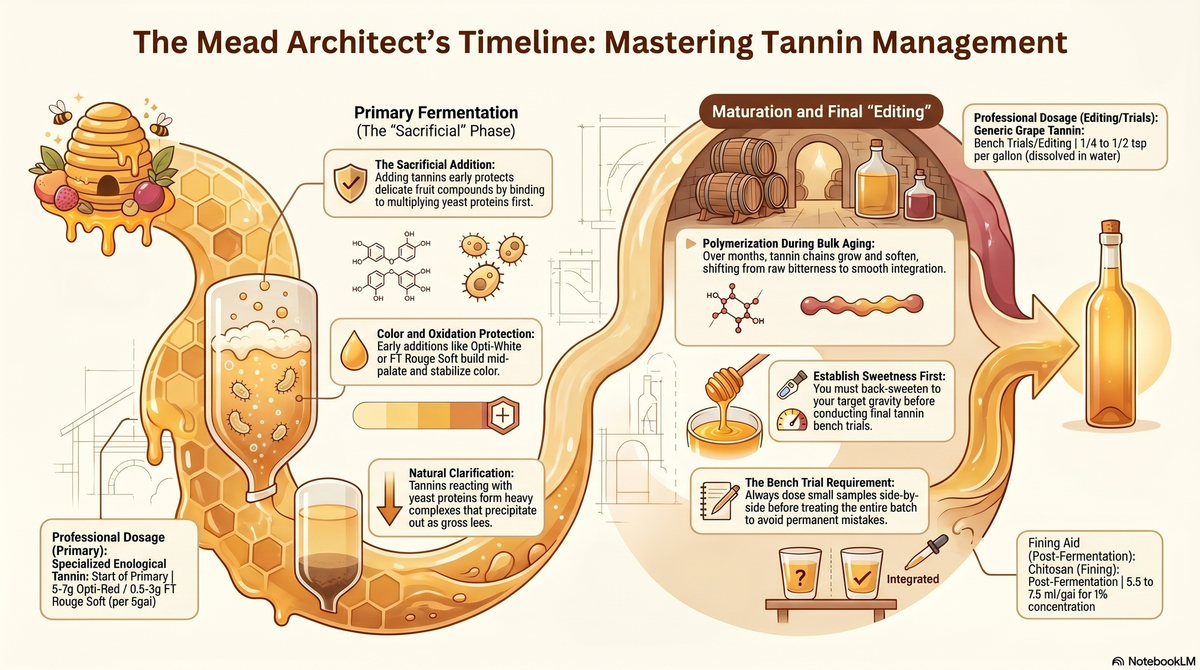
- Opti-Red and FT Rouge Soft are designed for big fruit meads and pyments with serious color and body goals. NHC gold-medal recipes have used these in combination: typically 5–7 grams of Opti-Red alongside 0.5–3 grams of FT Rouge Soft per 5–6.5 gallons (19–25 liters), added at the start of fermentation.
- Opti-White and FT Blanc are for lighter meads and white wine styles. Added early in primary, they build mid-palate structure and protect against oxidation while imparting a perception of sweetness in dry meads — without harsh astringency. That last bit is worth repeating: they can make a bone-dry mead taste less austere. That's a useful tool.
Natural Teas are a traditional tannic addition and can add additional flavors. However, they tend to have higher variability as they are usually dried leaves (whole, crushed, or powdered) and can often degrade in shipping and storage. Purchase the best quality you can afford, and bench trial so you can calculate the right levels for additions.:
-
Green Teas work well in primary and add tremedous mouthfeel. They do tend to impart an herbal quality, and can add a yellow/green tint. Roasted green tea adds a lightly nutty character.
-
Black Teas also work well but add a more generic tannin profile. While this works well in primary, it also works well in secondary to adjust both flavor and texture. If you use a fermented tea, be aware you may have a higher risk of bacterial contamination.
-
Herbal Teas work but also usually add herbal flavors that are detectible. I would not recommend for a Traditional, but you do you. This is a great way to create a metheglyn.
-
Preparation is fairly easy, either dry into the fermenter or prepare a brewed tea to use for addition. The latter tends to give you more control based on strength of the tea and their flavors. Brewing a tea is also a safer way to prevent bacterial contamination if you brew with hot water, and let it sit for a few minutes to pasteurize.
When to Add What: A Timeline
Primary Fermentation — The Sacrificial Phase
Adding commercial tannins at the start of fermentation isn't about building final flavor. It's about biochemistry. Those tannins are going to bind to multiplying yeast proteins and drop out with the gross lees — that's expected. The point is that by sacrificing themselves in this way, they protect the more delicate, native fruit-derived tannins from precipitating out too. You're essentially using inexpensive tannins to preserve the ones that matter. For fruit-forward meads, this is how you protect long-term color stability and structural integrity.
Secondary and Bulk Aging — The Slow Transformation
As your mead moves into bulk aging, trace oxygen is oxidizing alcohols into acetaldehyde, which acts as a molecular bridge linking tannins with anthocyanins — the fruit pigments. This is why a heavily-tannic dark fruit mead made with black currant, elderberry, or serious oak might taste brutally astringent at six months and revelatory at two years. Those massive polyphenol chains polymerize, grow heavy, and precipitate out, converting raw bitterness into something soft and integrated. High-tannin meads age incredibly gracefully. They just require patience and trust.
The Editing Phase — Sweetness First, Everything Else Second
Here's the sequencing that trips people up. The editing phase — where you dial in final balance — actually starts during recipe formulation, not at packaging. You cannot balance a heavy tannin load without targeting the right residual sweetness from the beginning. A delicate tart cherry mead might land in balance around 1.034 final gravity. A black currant bomb with serious polyphenol load may need 1.048 or higher just to counteract the tannin intensity.
When you get to the actual bench work before packaging:
Sweetness first. Always. Sweetness balances both acid and tannin simultaneously. Adjust your back-sweetening target before you touch anything else.
Then evaluate TA and pH. A sweet mead without sufficient titratable acidity reads as flabby and flat. Too low a pH with high TA and it reads sharp and aggressive. You're looking for the intersection.
Then bench trial your tannin additions. Pull measured samples of your sweetened mead. Dose them with varying amounts of acid (malic, tartaric, or citric) or finishing tannin solution. Taste side-by-side. Find your target dose. Then — and only then — treat the whole batch. Throwing an additive blindly into five gallons (19 liters) without bench trials first is how you make a very expensive mistake that you have to live with for a year or two.
Fining and Clarification — There's No Universal Protocol
The most important thing to understand about clarifying mead is that there is no single protocol that works for every batch. The right fining agent depends on what's in your mead, what's causing the haze, and what you're willing to risk losing in the process. Get that decision wrong and you may drop your mead clear while quietly stripping the acidity, fruit character, or body you spent months building. Get it right and you've got a brilliant, stable product that tastes exactly like you intended.
What is universal: cold crashing is your foundation. Drop your mead to near-freezing for several days before you reach for any chemistry at all. You'll knock out an enormous amount of suspended yeast, protein, and particulate material, and whatever fining agent you use afterward will work better, require less, and carry less risk. Cold crashing isn't optional — it's step one.
From there, the agents you're choosing between behave very differently, and matching the right tool to your specific situation matters:
Bentonite is the workhorse, and there's a strong argument for getting it into primary fermentation rather than waiting until you have a clarity problem to solve. It's a negatively-charged clay that binds to positively-charged proteins and yeast material, pulling them down as it settles. Early addition means it handles the bulk of your protein load before it ever compounds into a stubborn haze. The catch is that bentonite lees are fluffy — compact them carefully and expect to lose some volume at racking if you haven't cold crashed thoroughly first.
Polyclar (PVPP) targets a different problem: oxidized polyphenols. These are the tannin compounds most responsible for browning and phenolic haze in lighter, more delicate meads. It won't touch your acid structure, making it a lower-risk option when you're working on a traditional or a melomel where brightness and color are priorities. Think of it as a finishing polish rather than a first-stage treatment.
Isinglass has been doing this job for centuries and earns its reputation. Positively charged, it pulls out negatively-charged yeast cells and fine particles that bentonite can sometimes miss. It's generally considered gentle on flavor and works well as a second-stage treatment after bentonite has done the heavy lifting. Worth noting: it's animal-derived, so it's off the table for vegan-friendly meads.
Super-Kleer (kieselsol and chitosan) is fast and effective — it can drop a hazy mead to brilliant clarity in 12–48 hours, which is genuinely useful when you're on a deadline. But approach it with caution. Chitosan in particular may strip titratable acidity by binding to organic acid anions, and there are reports of it pulling delicate fruit character along with the haze. It's a tool worth having, but probably not your first reach in a mead you've been carefully balancing. If you do use it, consider whether the speed is actually worth the risk on that particular batch. Of course, your mileage may vary. I've used this on many meads and won medals with them.
The broader lesson here is to bench trial your fining agents the same way you bench trial acids and tannins. Pull a small measured sample, treat it, give it time, taste it critically. What clarification costs you in any given batch depends entirely on what's in that batch — and you'd rather find out on four ounces (120 mL) than on five gallons (19 liters).
If you're running the mead through mechanical filtration for final polish, 0.45 μm absolute membrane filters will remove bacteria and yeast before bottling. Fair warning: the tighter the filtration, the more color, body, and flavor you're potentially leaving behind (and yes, there are many makers that don't believe this - make your own determination). And if there's fruit in your mead and you skipped pectic enzyme during fermentation, residual pectin will clog your filter pads almost immediately.
Final Rack, Stabilization, and Bottling
Finishing tannins bind residual proteins and settle out, so a final racking off that sediment before packaging is standard practice.
Two stabilization notes worth taking seriously:
If you back-sweetened, stabilize properly — potassium metabisulfite and potassium sorbate, in that order.
If you've had a malolactic fermentation, be very careful with sorbate. Malolactic bacteria will react with potassium sorbate and produce a permanent off-flavor that smells like crushed geranium leaves. It's not subtle, and it doesn't go away. If there's any chance MLF has occurred, know it before you stabilize. MLF is difficult to determine without chemical testing. It's also a great process to soften acidity and add complexity, a light "buttery" feel adding some diacetyl, think of a really nice Chardonnay.
Throughout racking and bottling, protect from oxygen. Purge your vessels with CO₂. Keep your sulfite levels correct. The polymerized tannin structure you've spent months building will oxidize into stale, flat flavors if you're careless at the finish line.
Further Reading
- 10 Tips for Making Great Mead — American Homebrewers Association
- The Mead Making Process and Advanced Topics in Mead-Making — BJCP Study Guide
- Kieselsol and Chitosan in Fruit Meads — Experimeads
- Kieselsol and Chitosan in a Traditional Mead — Experimeads
- Acid Additions in a Traditional Mead — Experimeads
- Influence of Water Chemistry on Fermentation and Flavor Profiles of Traditional Mead — American Homebrewers Association
- NHC Winning Mead Recipes: Observations and Discussion — Reddit / Zymurgy Magazine