
On AI/LMM Usage
Yes, I use LMM's for writing and some image generation...
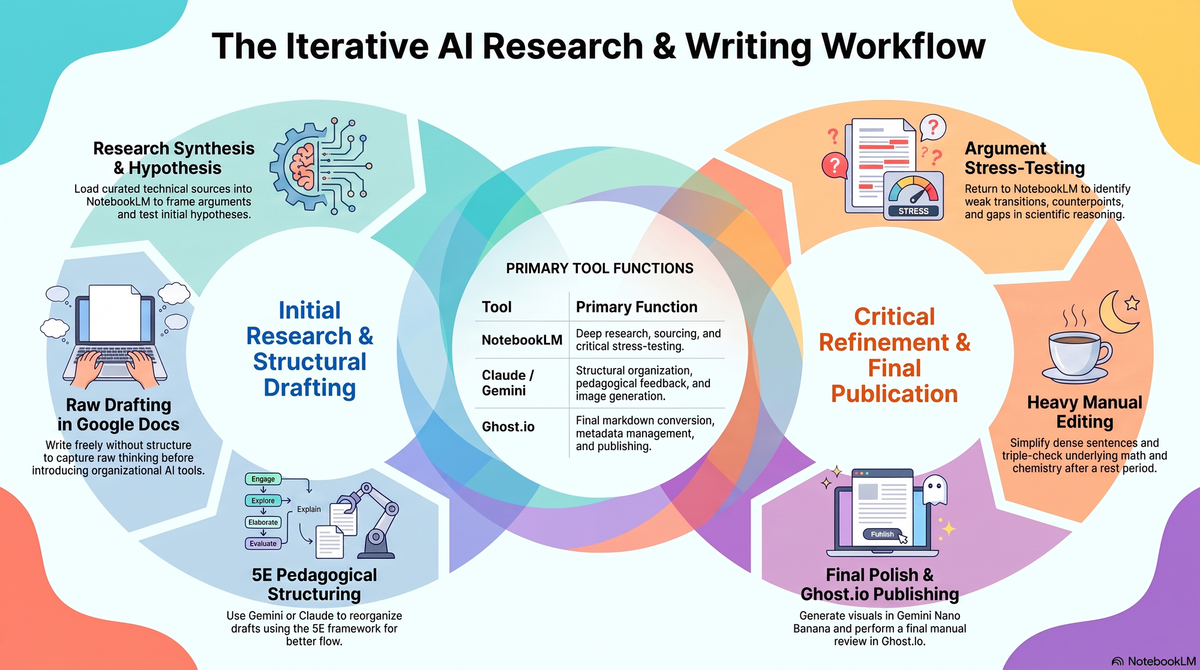
I've heard from a number of readers, rightly, who are concerned about the use of AI — more precisely, large language models (LLMs) — in content creation. It's worth addressing directly, because while those concerns are legitimate, the apocalyptic framing of AI that circulates online is largely unhelpful. There are real, large-scale questions about infrastructure security, economic disruption, and privacy, but these are not unique to AI; the same arguments apply to social media, modern marketing, credit card and online purchasing systems, and password management generally. Still, I have to respect your opinion and give you the opportunity to decide if this site is for you.
Some background: I hold a BFA in Fine Arts from Kansas State University, along with two years in the university's Architecture design studio. My career since has spanned printing, marketing, technical writing, business development, and high-technology roles, with hands-on experience across design, production, relationship management, and communication. I began working with LLMs in their early, inconsistent days, and as the models matured, I found them increasingly valuable for research, analysis, and content development. Today, Claude and Gemini are core parts of my workflow.
After a career transition, I used LLMs to build study materials and rubrics for the BJCP Written Exam, which considerably streamlined the process of preparing for that assessment. I submitted the rubric to the BJCP for review and received encouraging feedback. I haven't yet retaken the written exam, but I intend to.
My current role as a school district IT Director gave me access to sandboxed instances of ChatGPT, Claude, Claude Code, and Google Workspace's Gemini tools. I also maintain personal subscriptions to the tools I use regularly outside of work: Google One and Claude.ai.
The Toolkit
Google NotebookLM is my primary research tool. I maintain several notebooks across different topics and disciplines; for this blog, one large notebook holds curated sources ranging from MBAA and Seibel technical material to YouTube content and homebrew forum discussions that engage seriously with the science rather than repeating folklore. Within a notebook, I can highlight specific sources, ask questions, propose and test a thesis, and iteratively refine the argument. NotebookLM's audio, video, presentation, mind map, and infographic features are useful for approaching a project from multiple angles — I'll often take a nearly finished piece, isolate it as a source, and generate an audio discussion of it specifically to stress-test the content for weak claims, unclear presentation, or gaps in argument, while making sure the final piece still sounds like me rather than the model. Output can also be tuned to strip out AI-typical phrasing and stylistic tics, and notebooks can be revisited and revised indefinitely, which makes them useful as living references for mead, historical beer research, and other ongoing threads.
Gemini, through custom Gems, functions as a configurable consultant persona that can be given notebooks as source material. It supports a more conversational style of feedback and broader web search than NotebookLM, with somewhat looser guardrails — useful for surfacing current discussion from forums or Reddit on a given topic. That looseness comes with a cost: general-purpose Gemini will confidently fabricate information, so its output has to be checked against sources rather than trusted outright. The persona prompt can be edited to adjust tone and behavior as needed. For image generation, Google's Nano Banana model has been a reliable workhorse for illustrations and infographics, though its output still requires careful proofreading before use.
Claude offers largely equivalent capabilities to Gemini, but in my experience produces more refined output with a lower tendency toward fabrication. I'm also developing software with Claude Code that I'm not ready to discuss publicly and may ultimately keep as a personal tool rather than release. The pace of change in model releases, subscription tiers, and efficiency tuning on Anthropic's end has, at times, made that work less predictable than I'd like.
ChatGPT has produced results ranging from excellent to unusable in my experience. I don't currently recommend it as part of this workflow, though I know capable writers who rely on it successfully — results here seem to vary more by user and use case than with the other tools.
The Workflow
Ideas for articles tend to surface unplanned, usually while I'm actively brewing or making mead — a question about yeast performance, a "how do I actually know this" moment that applies equally to beer or cider. I start by sketching a rough hypothesis and deciding whether it's worth pursuing. From there, I gather known sources, run searches, collect material and anecdotes, and load all of it into NotebookLM, where I begin framing the argument through questions and proposals. Responses that hold up against the argument get saved as notes and, over time, promoted to sources in their own right.
Once the argument feels reasonably clear, I move to Google Docs and write freely, without much structure — following tangents where they lead and getting the raw thinking down before worrying about organization.
That draft then goes to Claude or Gemini for organizational recommendations. I generally structure long-form pieces around 5E pedagogy, and my Gem uses that framework as a basis for suggesting structure, sharpening critical-thinking flow, and flagging weak transitions or unclear reasoning.
From there, the draft returns to NotebookLM for a closer pass: where is the argument weak, where are the credible counterpoints, is the science being represented accurately. Relevant points get copied back into the working document, and the piece goes through several more rounds of rewriting.
Then I step away — usually for several days — before returning with fresh eyes for a heavy edit. Slowing down is a skill that I struggle with. I have a persistent habit of overcomplicating sentences, so this pass is largely about simplification: breaking down dense sections, inserting missing context, and double- and triple-checking the underlying science, math, and chemistry. The revised draft goes back into NotebookLM for a final sanity check, with instructions to critique, reorganize, and flag anything that isn't earning its place.
At that point the piece is well-organized and grammatically sound, but usually still needs tightening. I look for places where a paragraph would work better as a table, and I'll ask Claude to rewrite specific sentences or sections to sharpen emphasis, soften anything unnecessarily controversial, or dial back attempts at humor that don't land on the page.
After another short rest, I select a passage to anchor the header image — typically an infographic — and generate several variations in Gemini's Nano Banana, choosing whichever best represents the point being made. For some posts, photos from an actual brew day serve the same purpose.
The final piece goes into Ghost.io for publishing: converting the document to markdown, adding text and metadata, uploading the image, and reviewing a side-by-side preview for final adjustments — usually matters of cadence, sentence structure, or walking back a line that reads as too strong on reflection. Ghost.io doesn't support automated cross-posting to forums or social platforms, so that distribution is handled manually.
A Note on Transparency
I expect this workflow will not sit well with everyone, and I understand why. My intent is not to have AI generate content wholesale, but to use it for curated research, organizational structure, critical review, and efficient infographic production. Every source I cite, I have read and verified myself, to make sure I'm representing it accurately.