Mash Steps for Modern Malt
Barley breeding has spent the last half-century optimizing for agronomics first and malting quality second. The malting industry, in turn, has spent that same half-century getting extremely good at compensating for whatever tradeoffs that optimization created.

Mash Steps for Modern Malt
Who is this article for?
Firstly, all grain brewers, but mostly those that buy in bulk and care about the vendors and malt sources they use. Many of us buy in bulk and work carefully to build out optimized recipes using those specific malts. Secondly, I like to do “historic” styles, but recognize that modern agriculture has advanced sufficiently in the past few decades to engineer out problems with modification and even specific staling precursors. Finding under-modified malts is nearly impossible, and we really don’t have the documentation or specifications to map apples-to-apples to modern malts.
I’m not really here to tell you what to do, just to offer some perspectives on modern malts and information to help you make better decisions.
Malt has dramatically changed in the last forty years, and maltsters won't lead with flavor. They'll lead with yield, disease resistance, drought tolerance, and with the fact that a modern two-row variety has to survive combine harvesting, truck transport, and six months in a silo before it ever sees a mash tun. Barley breeding has spent the last half-century optimizing for agronomics first and malting quality second. The malting industry, in turn, has spent that same half-century getting extremely good at compensating for whatever tradeoffs that optimization created.
The resulting kernel that behaves almost nothing like the barley your old recipe books were written around. Most of the step-mash schedules and techniques handed down through decades of homebrewing literature exist to solve problems that modern malting has already solved in modern malt. A protein rest. An acid rest. A full decoction sequence. In several cases, running them on modern malt actively undoes work the malt already did for you purposefully, at industrial scale, with better process control than your garage thermometer will ever offer.
The "traditional technique" impulse in homebrewing is mostly backward here. “Brewing Classic Styles” is an example of designing recipes for specific maltsters and techniques, but written 20 years ago, and there are numerous "historic" recipes all over the internet. Directly attempting to reproduce with modern malt alternatives will yield a different end result. BCS ss a great book, still relevant, but don’t expect general 2-row or pale-ale malt to behave or even taste the same after decades of industrial and agricultural changes. Same for hops, but we will touch on that later.
We reach for the old schedule because it feels more rigorous, more authentic, more like what a "real" brewer would do. Rigor that's solving a problem you don't have isn't rigor. It could be harming your flavors, foam, and mouthfeel.
What Malt Actually Is, and Where the Important Parts Live
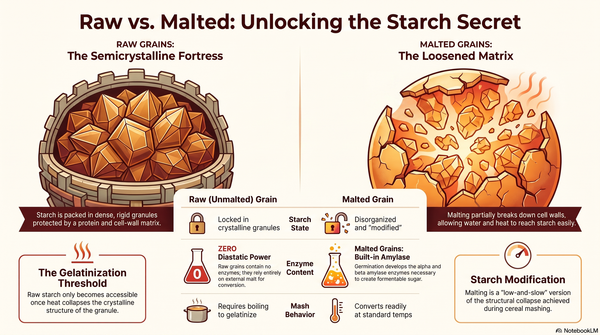
A barley kernel is a seed, and a seed's whole job is to keep a starch reserve locked up tight until conditions are right to germinate. That starch resides in the starchy endosperm, the bulk of the kernel's interior, and is packed as granules embedded in a protein matrix. Surrounding the endosperm is a thin, metabolically active layer called the aleurone, and it's the aleurone (working alongside the scutellum, the tissue connecting the endosperm to the embryo) that does the real work of malting. When the embryo germinates, it releases gibberellic acid, which signals the aleurone to start manufacturing and secreting a suite of hydrolytic enzymes, alpha-amylase chief among them, into the endosperm, causing the kernel to sprout.
Alpha-amylase isn't sitting in the raw grain waiting for you. It's synthesized during malting in response to a hormonal signal and diffuses inward from the aleurone toward the kernel's center over several days as germination proceeds. Beta-amylase, by contrast, is already present in the ungerminated grain, bound up in the endosperm and released as modification progresses. Malting is not "preparing" the grain in some vague sense, rather a controlled, multi-day germination run specifically to build and distribute the enzyme complement you're about to rely on, with cell-wall-degrading enzymes and amylases spreading from the aleurone and scutellum toward the kernel's crease as they break down both beta-glucan cell walls and starch granules along the way.
The maltster halts that process with kilning at whatever point of "modification" they've specified, and that stopping point is exactly what a Kolbach Index or diastatic power number reports back to you on the spec sheet. It's not marketing copy. It's a snapshot of how far along this internal saccharification project the maltster decided to let run before they froze it in place.
This is also why special rests or step mashes, as a concept, only make sense against a specific historical baseline: malt in which that internal degradation hadn't gone very far. Modern base malt arrives with the endosperm's protein matrix already substantially broken down and the enzyme complement already built and waiting. Unless you are intentionally targeting specific high-molecular-weight fractions to clear a stubborn colloidal haze, asking it to sit at 122–131°F (50–55°C) for twenty minutes isn't giving it a second chance to finish a job it left undone. It's asking already-scarce, already-mostly-spent protease activity to keep chewing on the mid-length, foam-positive proteins that survived malting because they're the ones you want in the glass, not because anyone missed them. It’s also why many brewers can now mash for as little as 20-minutes and still get a great yield.
What Actually Happens in the Mash
A mash is, at basic, a hot-water extraction of the milled/crushed malt grist with three things happening in parallel, but working against each other if you're not paying attention:
-
Starch conversion: Alpha- and beta-amylase, plus limit dextrinase quietly working on starch branch points, chopping gelatinized starch into fermentable sugars and residual dextrins. Where you land on the alpha/beta balance sets your fermentability and body. This is the one process in the list you actually want to encourage. Oh, and now, with maximum alpha- and beta-amylase activity, this happens relatively quickly.
-
Protein and haze-precursor management: Proteases and beta-glucanases, mostly spent by the time modern malt reaches you, finishing off whatever unmodified material remains and clearing beta-glucan gum that would otherwise choke your lauter. On well-modified malt, there's very little of this left to manage.
-
Polyphenol extraction: This is the one you're mostly trying to avoid, not encourage, and it has nothing to do with modification or enzymes at all. Husk tannins are soluble under high pH and high temperature, and their extraction is governed almost entirely by your mash and sparge conditions at the moment. Keep runoff below roughly 170°F (77°C) and mash pH under about 5.8, and husk polyphenol extraction will stay low regardless of which step schedule got you there. I want to separate this cleanly from everything else in this article: tannin management is a live, in-the-moment variable at the sparge, not a legacy problem that malt breeding solved or failed to solve. As long as you are managing your mash and lauter pH (or not lautering at all), tannic huskiness should not be an issue.
Two Efficiency Numbers, and Only One of Them Cares About Your Mash Schedule
I've written about this before in the System Efficiency piece, and it's worth a short reprise here because it's exactly the kind of confusion that keeps old mash habits alive on false pretenses.
-
Conversion efficiency is how much of the starch available in your grain actually gets turned into fermentable extract during the mash; it's the number that your enzyme activity and rest schedule can genuinely move, and it's dictated by the preset modification of the malt.
-
Lauter efficiency is how much of that converted extract you actually get out of the grain bed and into the kettle, and it's governed by crush, grain bed structure, sparge volume, and runoff pH/temperature, not by your mash.
Brewhouse efficiency then stacks every downstream loss, kettle, transfer, trub, on top of both. Conversion is a biochemical reaction involving some mechanical interactions, such as stirring and circulation. Lauter is largely mechanical, rinsing the sugars from the starch, with potential chemical interactions influenced by temperature and pH (which changes with temperature).
Confusing these is exactly how old mash schedules get defended on efficiency grounds that don't hold up under scrutiny. A protein rest might shave a percent or two off conversion variance on truly undermodified malt. It does essentially nothing for lauter efficiency on a modern, friable, well-modified grist, because the grain bed structure that determines your lauter speed was set by modification back at the maltster, long before your rest schedule ever got a chance to touch it. If your numbers are running low and you reach for a protein rest as the fix, you're very likely adjusting a knob that was never connected to the problem.
What Actually Drives Clarity, Mouthfeel, Foam, and Flavor
-
Clarity is driven far more by cold-side handling, kettle finings, cold crash, filtration, and by keeping beta-glucan and haze-active polyphenols in check than by anything a complicated mash schedule contributes on modern malt.
-
Mouthfeel and body come from the dextrin fraction your alpha/beta amylase balance leaves behind. That's a saccharification-temperature decision. It generally only requires a single mash rest, maybe two if you want more dextrins (mouthfeel).
-
Foam retention depends specifically on mid-molecular-weight, foam-positive polypeptides entering the finished beer. A protein rest, specifically, run on already well-modified malt, doesn't refine them; it may degrade them. It may also lower terminal gravity too far, stripping mid-length proteins, and dropping body from medium-full to thing and watery.This is the exact mechanism behind the "crystal clear, watery, no head" failure mode that keeps showing up in homebrewer accounts of witbiers and Vienna lagers gone sideways. You didn't fix the beer. Your mash schedule dismantled the part of it that was working.
-
Flavor stability is the one place modern breeding has added something genuinely new, rather than just compensating for an old problem. LOX-less barley varieties target the lipoxygenase pathway directly, reducing the trans-2-nonenal that drives cardboard staling, regardless of your mash schedule. This one's worth flagging early, because it recontextualizes the whole "old techniques, new malt" premise: not every change here is process compensation. Some of it is a genuinely new lever nobody had access to a generation ago, and it's a good example of modern ag actually giving brewers something rather than just taking something away and asking us to adapt. Some of you will argue, "What about Low Oxygen Brewing?" It’s related but not really applicable here.
Rest by Rest
For each rest below: the mechanism, the historical justification, what modern malt data actually tells you, and the recommendation.
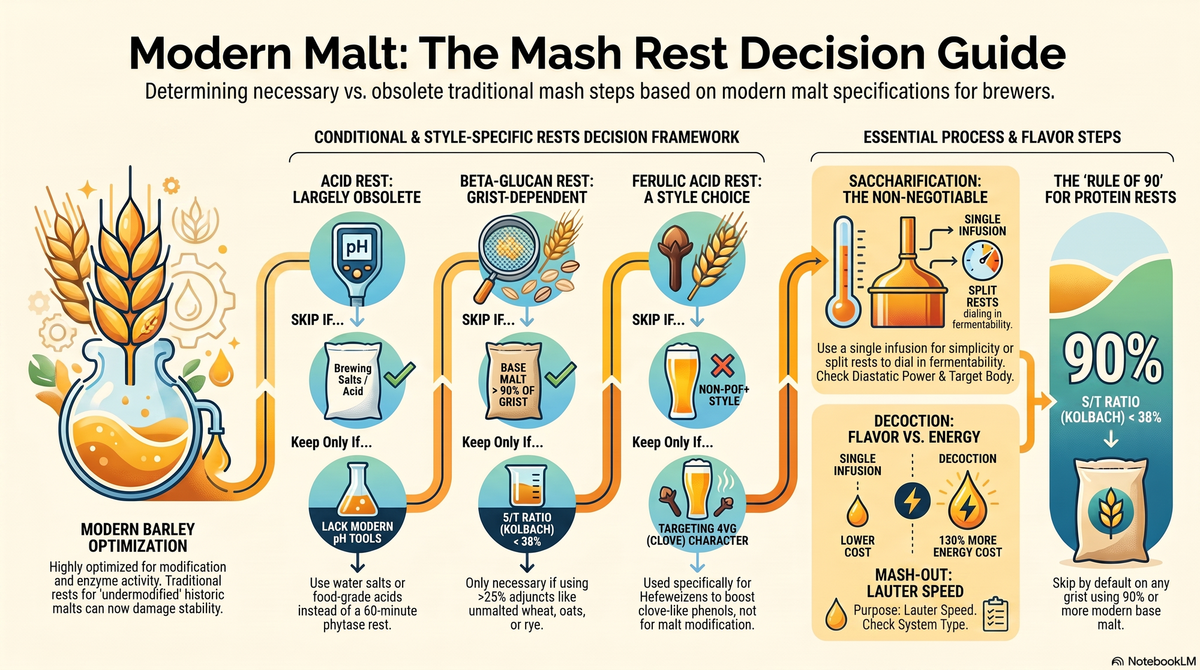
Acid Rest — 95–113°F (35–45°C)
pH adjustment via phytase activity. Largely obsolete compared with modern water-chemistry tools, acidulated malt, food-grade lactic or phosphoric acid, and calcium salts, all of which hit your target pH faster and more predictably than an hour-long phytase rest ever will. Most modern malts won't offer much benefit from the acidity angle specifically, though the same temperature band does real, separate work on beta-glucan. Historically, this may be where the term "dough-in" came from: hand-mixing the grist with a little water and letting it rest.
Recommendation: Skip it for pH purposes on any modern grist. Handle pH with additions. That's what they're for.
Beta-Glucan Rest — 95–113°F (35–45°C)
The one legitimate survivor of this whole family, and only conditionally so. In fully modified malt, beta-glucans shouldn't be a problem at all. But any beer running more than roughly 25% adjunct load, wheat, oats, rye, can genuinely benefit from a brief 15-minute rest here or a cereal mash with a small amount of your base malt to aid gelatinization. Keep in mind that flaked cereals are already converted - they don’t need that separate rest.
Recommendation: This is grist-dependent, not malt-dependent. The rest is about what you added on top of your base malt, not something your base malt failed to do.
Protein Rest — 122–131°F (50–55°C)
Historically, this rest degraded excess long-chain proteins in undermodified malt, improving lauterability and cutting haze risk. On modern, well-modified malt, the original justifications, excess protein degradation, mash efficiency, and lauterability, are largely non-issues and very little proteolysis actually occurs during a modern protein rest, because most protease activity has already been spent during malting itself. Worse: what little activity remains keeps working on the mid-length, foam-positive proteins that survived malting because they're wanted in the finished beer, not because anyone overlooked them.
Commercial-scale process engineering confirms this from the opposite direction, which I find more convincing than any homebrew forum debate: breweries eliminating the protein rest entirely cite time and energy savings, plus reduced lipoxygenase-driven lipid oxidation from a shorter, lower-temperature overall mash.
Recommendation: Skip by default on any grist that's roughly 90% or more modern base malt. Reserve it for high-raw-wheat witbier, six-row-heavy high-adjunct lagers, or any malt whose spec sheet shows an S/T (Kolbach Index) below roughly 38%. If your malt bag doesn't come with a spec sheet, that's a separate problem. Read your malt sheets!
Ferulic Acid Rest — 104–122°F (40–50°C)
The deliberate exception that proves the rule. This rest isn't fixing a modification problem at all; it's targeted flavor chemistry for one specific style family: hefeweizen, and some Belgians. The rest is essential for creating 4-vinyl guaiacol, and controlled German trials found that longer rests shift the balance from ester-dominant toward phenol-dominant character: no rest scored roughly 4.1 for perceived ester intensity, compared with 1.2 for phenol; a 20-minute rest flipped that ratio to 2.6 esters against 3.3 phenols.
Intellectual-honesty caveat, because I try to hold this site to that standard: a Brülosophy tasting panel couldn't reliably distinguish weissbiers brewed with and without the rest. So treat this one as "worth trying if the style calls for it and you want to dial the ester/phenol balance," not as gospel you're failing the style by skipping. That said, Live Oak Brewing in Austin still decocts their hefeweizens, but imports European malt to their specification, and it’s delicious.
Recommendation: Style-specific inclusion, not a workaround for modification. Your call on whether the balance shift is worth the extra step for your palate. Regardless, this can negatively impact your foam retention.
Saccharification Rest(s) — Single vs. Split
The one rest nobody's seriously arguing to eliminate. A single infusion at 152°F (67°C) works well for well-modified malt with adequate diastatic power. Splitting into a 145°F (63°C) beta-heavy rest and a 158°F (70°C) alpha-heavy rest is a fermentability dial. It's about the beer you want, not the malt you have.
Recommendation: Choose based on target attenuation and body. Not tradition.
Mash-Out — 168°F (76°C)
Still useful for viscosity control and lauter speed. Entirely unrelated to the modification argument running through the rest of this piece, don't let it get folded in by accident just because it's also a "step."
Decoction
The biggest, most emotionally loaded technique here on the list, and genuinely contested even among professional brewers, so let's be fair to both sides.
-
For: Decoction loyalists describe a "layered malt flavor," a depth they don't believe melanoidin malt fully replicates — even though melanoidin malt is explicitly marketed as a substitute for exactly this.
-
Against: A single-decoction mash uses more than 130 percent of the energy of a single-infusion mash, per Siebel Institute figures — a real, measurable cost for a technique whose core modification justification is dead on modern malt.
Where I land it: Decoction's remaining case isn't about modification at all. It is a flavor-development technique in the same family as a kilning choice: a legitimate reason to keep doing it if you like the result, not a mash-mechanics necessity. If you decoct because you love the process and the flavor it gives you, that's a completely defensible reason. Again, Live Oak. They do it to match their impression of German hefes, and it is arguably the beer that keeps their lights on. If you visit Austin, make sure you visit!
Chasing Historic Styles With Modern Ingredients Doesn't Get You a Historic Beer
This deserves its own section because it's the uncomfortable implication a lot of "authentic historic recipe" content quietly steps around: running an old mash schedule solely for the sake of modification on modern malt won't magically resurrect an 1870 flavor profile. If you are step-mashing or decocting, it should be a deliberate choice to leverage thermal reactions, extract specific Hussong-style husk characters, or alter mash concentration and is not a workaround for a modification deficit that no longer exists. It produces a modern beer with a longer, less efficient brew day.
The base grain itself has changed, genetically, chemically, and in the malthouse process, at every level that matters. Modification target. Enzyme complement. LOX activity. Protein profile. A protein rest or a decoction sequence was calibrated against a specific, now largely extinct, malt substrate and chasing the process without the substrate for which it was built doesn't restore the original outcome. It adds time and energy and, per the mechanisms above, sometimes actively moves the beer further from the historic result, stripping foam and body character that the period malt would have retained on its own.
If you want a defensible "historic" project, let recast as: this is my modern interpretation of the style, using a process inspired by historic technique. That's a genuinely good, worthy project; I'd encourage anyone to pursue it. It's just a different claim than "I brewed it the old way and it tastes as it did in 1870," because the single biggest variable in that sentence, the malt itself, evolved before you ever heated a kettle.
Hops Are the Same Story, and It's Worse — Because There's No Translation Table
This gets equal billing, not a footnote, because the malt argument at least should have good spec-sheet data to reason from. Hops don't, and that's the part I want to sit with for a minute.
Modern hop varieties have been bred hard for alpha-acid content, disease resistance, and yield, the same agronomic pressures barley has been under for the same reasons. A "historic" hop variety grown today is frequently not chemically identical to what carried that name a century ago, even before you get anywhere near processing format.
And then processing format stacks a second, larger layer of difference on top of that. Whole-cone hops are the closest thing to the historic baseline, but even whole-cone today isn't neutral; modern cleaning, kilning, and handling practices have all changed.
Pelletizing crushes the lupulin gland and exposes resin directly to the wort, and side-by-side data show that pellets and cones don't even convert alpha acids in the same way during the boil. The increase in oxidized alpha acids from pellet use varies meaningfully by variety, which is precisely why predicting IBU contribution from pellets is measurably harder than from cones.
Then there's CO2 extract, which strips out the vegetal matter and polyphenols entirely and delivers oils and acids as a nearly bare concentrate with no cone-based analog to convert back from. And at the far end, cryo/lupulin-powder hops isolate the lupulin gland via cryogenic separation, delivering roughly double the alpha-acid and essential-oil content of a standard T90 pellet from the same variety.
Because a clean, mathematical conversion table across these processing lines doesn't exist, recreating historic hopping requires sensory artistry and careful bench trials rather than relying on a simple weighted-best-guess heuristic. You can't take a historic whole-cone hopping rate and reliably back-calculate an equivalent cryo-pellet addition, because the transformation isn't a clean concentration factor. Different varieties oxidize and isomerize differently between cone and pellet form. Dry-hop aroma extraction varies by format, even at matched alpha acid levels. Nobody has published a rigorous per-variety, per-format translation table (that I can find) because the underlying chemistry genuinely doesn't reduce to a single clean number.
Brewers are largely operating on "roughly half the weight" heuristics for cryo hops and variety-specific fudge factors for pellets, which is a meaningfully weaker epistemic position than the malt side of this article, where at least a Kolbach Index or diastatic power figure gives you something to reason from. When they change forms, it may take several trials to get a good result replicating a flagship house beer.
So if the malt argument is "the mash schedule can't restore the original substrate," the hop argument is one step worse: we don't even have reliable math to translate the modern substrate back into historic terms in the first place. Anyone chasing a truly historic hop character is fighting a breeding program, a processing-format problem, and a missing conversion standard, simultaneously. It's worth being direct about that rather than hand-waving it with a fudge-factor substitution and calling the result "authentic." Call it a good modern beer inspired by an old one instead. That's still a compliment.
Decision Framework
Here's an information table used to make decisions about recipes and techniques.
| Rest | Historical purpose | Still needed if… | Skip if… | What to check |
|---|---|---|---|---|
| Acid rest | pH correction | Almost never, on modern malt | You have salts or acid on hand (you should) | N/A — use additions instead |
| Beta-glucan rest | Lauter viscosity control | Adjunct load (wheat/oat/rye) > ~25% | All-malt, low-adjunct grist | Grist composition, not malt spec |
| Protein rest | Haze/lauter/efficiency on undermodified malt | S/T below ~38%, high raw wheat, six-row-heavy adjunct lager | Modern 90%+ base-malt grist | Kolbach Index (S/T ratio) |
| Ferulic acid rest | N/A — flavor-targeted, not modification-driven | Hefeweizen, POF+ yeast styles wanting clove character | Any style not targeting 4VG | Style choice, not malt spec |
| Saccharification | Starch conversion | Always — choose single vs. split by target body | Never skippable | Diastatic power, target attenuation |
| Mash-out | Viscosity/lauter speed | Batch or fly sparge systems that benefit | Simple single-vessel no-sparge setups | N/A |
| Decoction | Historically modification; now, flavor only | You want the flavor and accept the energy cost | Modification is your only stated reason | N/A — this is a taste decision now |
Closing
The next wave of malt breeding is optimizing for flavor stability — the LOX-less work is a genuinely different axis from the modification story that's been running through this whole piece. We've spent a long time getting precise about what malt modification means for a mash schedule. We've spent almost no equivalent rigor on translating hop character across formats, and that gap is bigger than most brewers give credit.
Read your spec sheet before you reach for the old schedule. It's telling you exactly what work has already been done, and exactly what's left for you to do at the kettle.
Sources
-
Briess, "Understanding a Malt Analysis" — DP and S/T threshold values, maltster-stated minimums
-
BYO, "Understanding Malt Spec Sheets" — S/T and DP interpretation
-
ProBrewer, "Understanding Malt Analysis Sheets" (Greg Noonan) — DP-by-malt-type reference figures
-
Hirota et al. 2006, Cereal Chemistry 83(3), 250–254 — original LOX-less brewing performance data
-
ScienceDirect, "Breeding of lipoxygenase-1-less malting barley variety 'SouthernStar'" — peer-reviewed LOX-less varietal data
-
Coghe et al., PubMed, "Ferulic acid release and 4-vinylguaiacol formation during brewing and fermentation" — KU Leuven brewing science group
-
Craft & Brewing, "Traditional Hefeweizen: Worth the Trouble?" — German ester/phenol rest-length data
-
Malteurop, "Decoction Mashing: the collision of tradition and craft" — Siebel Institute energy-cost figures
-
U.S. Patents 10,450,539 and 11,873,470 — commercial process engineering on eliminating the protein rest
-
PMC, "Secretion of α-Amylase by the Aleurone Layer and the Scutellum of Germinating Barley Grain" — enzyme synthesis and migration mechanism
-
Sound Brewery / Beer and Gardening Journal — tannin extraction pH and temperature thresholds
-
Deutsche Beverage & Process, "Brewhouse Efficiency: Conversion, Lautering, & BH Yield" — efficiency-tier definitions
-
alchemyoverlord, "Hop Cones vs. Pellets: IBU Differences" — variety-dependent oxidized alpha-acid data
-
BarthHaas, "Whole Cone Hops vs. Pellets vs. Extract" — processing format definitions
-
Mangrove Jack's / Beer Maverick — cryo/lupulin powder concentration figures