The Mead Stability Manifesto: Delle Units and Beyond
In the pursuit of the perfect sweet mead, the "bottle bomb" is the ultimate horror story, except maybe broken glass carboys.

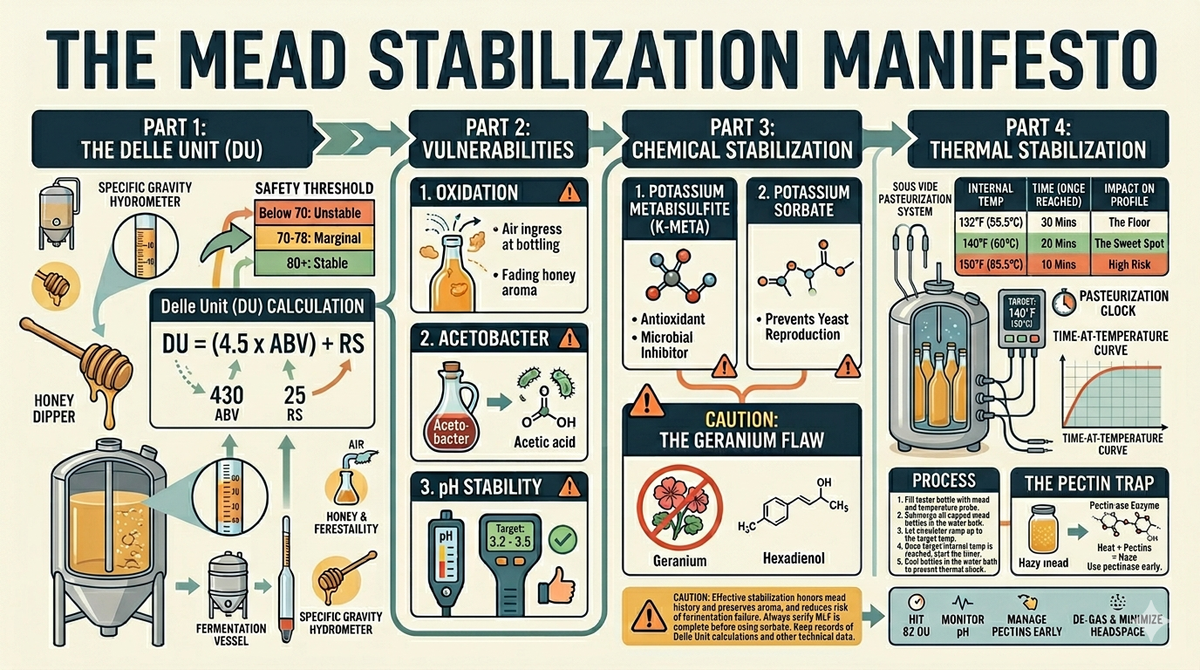
We’ve all been there—trying to preserve that delicate honey character while leaving enough residual sugar to balance the acidity, only to wonder if the yeast is truly done or just napping.
To sleep soundly, we need more than just a prayer; we need the mathematical and chemical framework to ensure bottle stability
Part 1: The Delle Unit (DU)
The Delle Unit is a measurement used to predict whether a beverage is biologically stable. It calculates the combined "hostility" of your mead toward spoilage organisms by weighing the inhibitory effects of ethanol and sugar. In this calculation, ethanol is considered roughly 4.5 times more effective at stopping yeast than sugar.
The Formula
$$DU = (4.5 \times ABV) + RS$$
- ABV: Alcohol by Volume (e.g., 14).
- RS: Residual Sugar (measured in $g/100ml$, or $% w/v$).
Accidentalis Tip: To find your RS from Specific Gravity, use the approximation: $(SG - 1.000) \times 25$. For example, a finished gravity of 1.020 is roughly 5% residual sugar.
The Safety Threshold
The generally accepted number for biological stability is 82 Delle Units.
| DU Range | Stability Status | Risk Level |
|---|---|---|
| Below 70 | Unstable | High risk of "bottle bombs" or haze. |
| 70 – 78 | Marginal | Use caution; keep cold or stabilize chemically. |
| 80+ | Stable | Yeast metabolism is generally halted by osmotic pressure. |
Part 2: Vulnerabilities Beyond the Number
Even a mead with 85 Delle Units isn't invincible. High alcohol and sugar won't protect you from chemical or environmental spoilage.
- Oxidation: This is a chemical process, not a biological one. High DU won't stop oxygen from turning your bright orange-blossom aromatics into wet cardboard.
- Acetobacter: These bacteria actually crave alcohol to produce acetic acid (vinegar), and they can persist even in high-ABV environments if oxygen is present.
- pH Stability: A high pH (>4.0) makes it easier for hardy bacteria like Lactobacillus to gain a foothold. Keeping your pH in the 3.2–3.5 range creates a "synergistic hurdle" that makes your alcohol and sulfites more effective.
Part 3: The Practical Guide to Stabilization
A. Chemical Stabilization (The Duo)
You must use both of these together; neither is a "silver bullet" on its own.
- Potassium Metabisulfite (K-Meta): Releases $SO_2$ to stun wild microbes and act as an antioxidant. Undetectable at correct levels; "burnt match" notes if over-used.
- Potassium Sorbate: Prevents yeast from reproducing (budding). Some perceive a slight "bubblegum" note.
[!CAUTION]
The Geranium Flaw: Never add sorbate if you suspect Malolactic Fermentation (MLF) is occurring. Lactic acid bacteria will consume the sorbate and produce hexadienol, which smells like crushed geraniums—a permanent, irreversible flaw.
B. Thermal Stabilization (The "Gentle" Sous Vide Method)
Using a sous vide circulator allows for precision heating. To avoid thermal shock (breaking the glass) and to minimize gas expansion that can pop corks, always start with your bottles in a room-temperature water bath and let the circulator bring the mead up to temp gradually.
[!WARNING]
The Pectin Trap: Heat is the enemy of an "unpolished" mead. If your fruit was not treated with pectinase (pectic enzyme) during primary or secondary, or if the mead is still hazy when it hits the water bath, the heat MAY lock in a permanent haze. High temperatures cause pectin chains to bind, creating a cloudy suspension and possible bottle sedimentation that no amount of aging will clear.
| Internal Temp | Time (Once Reached) | Impact on Mead Profile |
|---|---|---|
| 132°F (55.5°C) | 30 Minutes | The Floor: Best for preserving delicate honey esters. |
| 140°F (60°C) | 20 Minutes | The Sweet Spot: Best balance of safety and flavor. |
| 150°F (65.5°C) | 10 Minutes | High Risk: Likely to induce "cooked" flavors and pectin haze. |
The Process:
- Confirm Clarity: Ensure the mead is brilliant and pectin-free before heating.
- Load: Place capped bottles into room-temperature water.
- Ramp & Monitor: Set circulator to target (e.g., 140°F). Use a "probe bottle" to track internal temperature.
- Hold: Start the timer only once the internal mead temperature hits the target.
- Cool: Let the bottles cool in the water bath naturally to avoid shocking the glass.
Final Stability Checklist
- Hit 82 DU: Leverage the combined power of ABV and RS.
- Monitor pH: Target 3.2–3.5 to keep the environment hostile to bacteria.
- Check for MLF: Ensure no lactic acid bacteria are active before using sorbate.
- Enzyme Polish: Confirm pectic enzymes have finished their work to avoid "setting" a haze during pasteurization.
By layering these methods—mathematical (Delle Units), chemical (pH and Sulfites), and thermal (Precision Pasteurization)—you move from "hoping" to "knowing" that your mead is safe for the cellar.